downloading the data files a package cannot ship


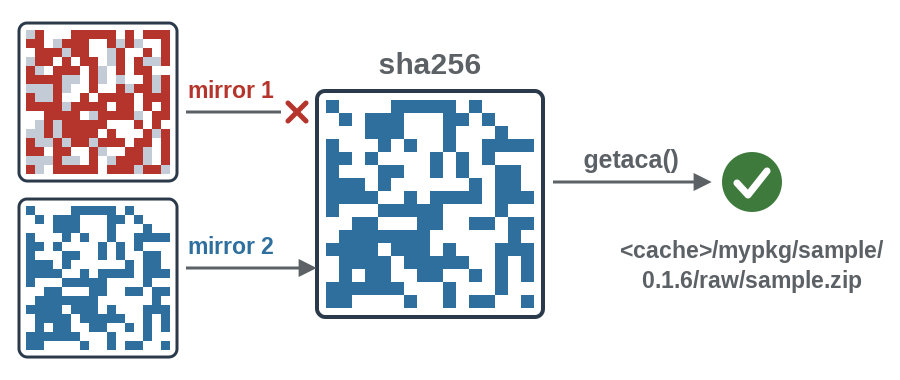
getaca retrieves, verifies and caches the large files an R package needs but cannot ship, such as a reference dataset, a trained model or an archive of examples.
A package declares each file as a resource: a name, a version, the URLs that serve it and the SHA-256 checksum of its bytes (the Secure Hash Algorithm with a 256-bit digest). The declarations form a registry that ships inside the installed package. getaca resolves a request through an explicit policy, checks what arrives against the checksum, records where it came from and returns an ordinary local path, so the same installed package resolves the same bytes on every machine. You decide whether the declaration stays fixed with each release of your package or follows a remote registry that you maintain.
getaca supports:
R CMD check
resolution is offline whatever policy is set, and three helpers keep
tests, examples and vignettes passing when a resource is not cached (Surviving R
CMD check and CI).actor field (user, author or
upstream), so a declaring package can catch the ones that reach the
person running it and answer in its own words.getaca_info()
reports the mirror that served the bytes, the registry state that chose
them, the licence, the digital object identifier (DOI) and when the copy
was fetched and last verified.Hashing follows the Secure Hash Standard (Federal Information Processing Standard 180-4), and signing follows Ed25519 (Request for Comments 8032). Both are implemented in C inside the package, and transfers go through curl.
Install the released version from CRAN. Windows and macOS get a binary and need no build tools:
install.packages("getaca")The development version compiles C code. Install the build tools for your operating system first:
| Operating system | Build tools |
|---|---|
| Windows | Rtools matching your R version |
| macOS | Run xcode-select --install in Terminal |
| Debian / Ubuntu | Install r-base-dev |
Check that R can find the compiler:
pkgbuild::has_build_tools(debug = TRUE)Then install getaca from GitHub:
# install.packages("pak")
pak::pak("gcol33/getaca")
The C code uses no external library. On Windows it links the system’s
bcrypt library, which supplies the random seed for a
signing key. The curl package needs libcurl, which on Linux is a system
package when curl is built from source.
resource(): its name, version, URLs
and SHA-256 checksum.registry().getaca(), which returns a
verified local path.The example declares a small zip archive from this repository, pinned to a release tag:
library(getaca)

url <- paste0("https://raw.githubusercontent.com/gcol33/getaca/v0.1.6/",
              "tests/testthat/fixtures/sample.zip")
sha <- "87d05c681c448a4fd0a88ca6e816f2f78f84319b7f02f7477be55995fc44c259"

sample_zip <- resource("sample", "0.1.6", urls = url, sha256 = sha)
reg <- registry(package = "mypkg", resources = list(sample_zip))

path <- getaca("sample", registry = reg)
path
#> [1] "<cache>/mypkg/sample/0.1.6/raw/sample.zip"
The cache lays the file out by package, name and version. A second call returns the cached copy without a transfer.
A transfer reports its progress in the console:

A resource can also carry the step that unpacks it, so the call returns the directory. The archive is verified first and unpacked once:
sample_dir <- resource("sample", "0.1.6", urls = url, sha256 = sha,
                       processor = unpack())
reg <- registry(package = "mypkg", resources = list(sample_dir))

dir <- getaca("sample", registry = reg)
list.files(dir, recursive = TRUE)
#> [1] "names.csv"           "tables/ranks.csv"    "tables/synonyms.csv"
The checksum has to come from the bytes.
registry_draft() takes the URLs, or a Zenodo, figshare or
Dataverse identifier, retrieves each file once and returns a registry
with the checksums filled in.
In a package, registry_write() stores the registry at
inst/getaca/registry.rds, and every later call reaches it
with the package name alone:
path <- getaca("sample", package = "mypkg")Declaring Resources covers the full record, with mirrors, sizes, licences, DOIs, parts, processors and credentials.
R CMD check runs without a network, so a package with a
4 GB dependency cannot download it there. Resolution falls back to
offline under check whatever the policy says, and three
helpers cover the places that need the file:
# in tests
getaca_skip_if_unavailable("backbone", package = "yourpkg")

# in examples and vignettes
path <- getaca_optional("backbone", package = "yourpkg")

# anywhere a logical reads better
getaca_available("backbone", package = "yourpkg")
A continuous integration (CI) job pointed at a pre-seeded
GETACA_CACHE finds every file already there. Surviving R
CMD check and CI gives the GitHub Actions setup and a CRAN
checklist.
A resource record is fixed: one name and version names one set of
bytes. A channel maps the name onto one record, and a channel can move.
The policy decides where that mapping is read from:
bundled, the registry shipped with the package (the
default); current, a remote registry with the bundled one
as fallback; pinned, a frozen local snapshot; or
offline, cached and bundled information only. A remote
registry that redefines a published version is rejected. Policies
and Channels describes each policy and how to sign a remote
registry.
A retrieval returns the bytes the package was built against, or an
error naming who can act on it. When several mirrors return identical
bytes that do not match the declared checksum,
getaca_error_declaration points at the registry. A
declaring package can catch a condition and answer in its own
vocabulary:
path <- tryCatch(
  getaca("backbone", package = "yourpkg"),
  getaca_error_unavailable = function(e) {
    stop("The backbone is not installed and no network is available.",
         call. = FALSE)
  }
)
Handling Failures lists every condition with its cause and the party who can fix it.
Bytes land in a temporary file named after the declared checksum, are
sized and hashed, and only then join the cache, so an interrupted
transfer never appears as a cached resource and resumes on the next
attempt. Two packages declaring the same file keep one copy.
getaca_catalogue() lists what the installed packages
declare and what the cache holds, and
getaca_clean(dry_run = TRUE) shows what the retention
sweeps would remove and why. The
Cache covers the layout, provenance, progress display and retention
settings.
A companion data package suits data that fits a repository and is released with the code. pins shares data sets, models and other R objects across projects through boards. BiocFileCache keeps a persistent cache of files that the user adds, updates and retrieves. pooch is the Python library that ships a registry of file names and hashes with a package. getaca is built around a package declaring what it needs, with a version that labels the data and channels that can move between releases. Choosing Between getaca and the Alternatives sets these side by side.
Start with Quick Start: one resource declared, retrieved, checked and cached.
Questions and bug reports go to the GitHub issues. A bug report is easiest to act on with a small reproducible example, for instance made with reprex.
Pull requests are welcome; see the contributing guide.
“Software is like sex: it’s better when it’s free.” — Linus Torvalds
I’m a PhD student who builds R packages in my free time because I believe good tools should be free and open. I started these projects for my own work and figured others might find them useful too.
If this package saved you some time, buying me a coffee is a nice way to say thanks. It helps with my coffee addiction.
The Curve25519 field arithmetic, point addition, Montgomery ladder and scalar reduction in the Ed25519 code are derived from TweetNaCl by Daniel J. Bernstein, Bernard van Gastel, Wesley Janssen, Tanja Lange, Peter Schwabe and Sjaak Smetsers, released into the public domain by its authors.
getaca is licensed under MIT. The Ed25519 code derived from TweetNaCl
is distributed under the same licence; inst/COPYRIGHTS
records its origin.
To cite getaca in publications use:
Colling G (2026). _getaca: Reproducible External Data Dependencies_.
doi:10.32614/CRAN.package.getaca
<https://doi.org/10.32614/CRAN.package.getaca>. R package version
0.2.0, <https://gillescolling.com/getaca/>.
BibTeX:
@Manual{colling2026getaca,
  title = {getaca: Reproducible External Data Dependencies},
  author = {Gilles Colling},
  year = {2026},
  note = {R package version 0.2.0},
  doi = {10.32614/CRAN.package.getaca},
  url = {https://gillescolling.com/getaca/},
}