The aim of geoarrowWidget is to facilitate fast transfer
of geospatial data between R memory and the browser using
GeoArrow memory layout. It also provides
JavaScript bindings for reading GeoParquet
files from remote URLs. It provides functionality to attach
GeoArrow and/or GeoParuet data to existing
htmlwidgets along with the relevant JavaScript
libraries to handle this data in the browser context.
It does not do anything useful beyond the data transfer. It is up to
the user/devloper to make further use of this data, e.g. render it
somehow, using JavaScript.
In theory, all functionality provided by geoarrowWidget
will also work for the native, i.e. non-geospatial implementations of
Arrow and Parquet data, but those are not
thoroughly tested.
Not on CRAN yet, so install from github:
remotes::install_github("r-spatial/geoarrowWidget")For testing purposes, geoarrowWidget provides a minimal
htmlwidget called geoarrowDummyWidget. Here’s
an example of how to use it:
library(geoarrowWidget)
library(wk)
library(nanoarrow)
library(geoarrow)

### generate some random sf points data ========================================
n = 1e5
dat = data.frame(
  id = 1:n
  , geometry = xy(
    x = runif(n, -160, 160)
    , y = runif(n, -40, 40)
    , crs = 4326
  )
)

### setup and write to tempfile as geoarrow ====================================
fl = tempfile()
dir.create(fl)
path = file.path(
  fl
  , "test.arrow"
)

interleaved = FALSE

data_stream = nanoarrow::as_nanoarrow_array_stream(
  dat
  , geometry_schema = geoarrow::infer_geoarrow_schema(
    dat
    , coord_type = ifelse(interleaved, "INTERLEAVED", "SEPARATE")
  )
)

nanoarrow::write_nanoarrow(data_stream, path)

### create widget and check browser console ====================================
wgt = geoarrowDummyWidget(file = path)

options(viewer = NULL)

wgt
This will create a web page with the data attached as a geoarrow object. In the browser console (press F12) this will look something like this (depending on the browser obviously, Librewolf in this case). You should see two entries:
Object - the geoarrow dataPerformanceResourceTiming - details about the
performance of loading the data including encodedBodySize
of the data in Bytes and duration in milliseconds.Another way to see how long it takes to load the data is to open the
Network tab in the developer tools and refresh the
page.
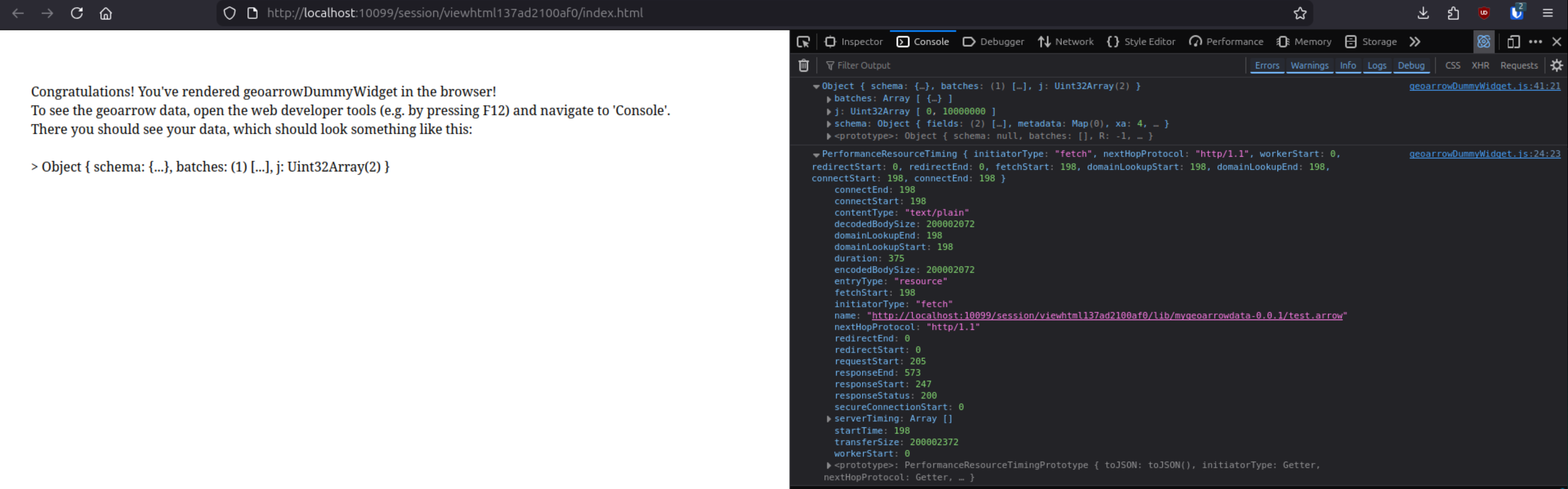 Note: the 200MB
encodedBodySize and 375ms duration in the
screenshot are the result of running the above code with
1e7 points.
The page source (press <CTRL + u>) will look something like this, where in line 11 you see the attached test.arrow file and above the necessary scripts (arrow and geoarrow JS bindings) to process the data further in JavaScript.

The general usage pattern is highlighted in these
lines of geoarrowDummyWidget
This project has been realized with financial support from the