

Area-frame and dual-frame survey design under real field cost. Survey
samples are usually designed for precision alone; the cost that actually
decides whether a survey happens is the field work: travelling between
sampling units and interviewing. fieldopt puts that cost
next to the variance of the estimator so that both are visible when the
design is chosen, and provides the pieces an agricultural survey with an
area frame (grid cells, points inside them) and a list frame needs.
travel_matrix() builds the travel matrix between units
from coordinates (great-circle or planar distances, optionally times a
detour factor), from a road network through OSRM (durations or
distances, in blocks), or wraps a matrix computed elsewhere.field_cost_model() turns travel, team-days, visits and
interviews into money or time.route_fieldwork() routes the field work from a depot
through the selected units, for one team or several, under daily limits
of duration (travel plus the service time at each unit), stops and
capacity, on symmetric or road-network matrices: exact up to 13 units,
otherwise a hybrid genetic search with the optimal split of the tour and
a granular local search (optimal on the classical TSPLIB instances and
on 24 of the 27 Augerat CVRP set A instances, largest gap 0.15%), with
the Held-Karp bound and a proof of optimality when it closes;
engine = "vrpr" hands the same problem to the PyVRP
solver.schedule_fieldwork() solves the multi-depot problem of
several bases with their teams and days (assignment, routes and the
number of team-days at once) and distributes the routes over the teams
and the days available: a calendar that says whether the field work
fits; schedule_calendar() redoes that distribution as an
integer programme (through highs) with team availability,
fixed assignments, precedences and shared team-days.select_units() draws a probability sample of segments
or cells, within strata, by the local pivotal method (spatially
balanced), by spatially ordered systematic sampling along a Hilbert
curve with interpenetrating replicates, by the cube method balanced on
auxiliaries, or by simple random sampling;
spatial_balance() measures how evenly a sample covers the
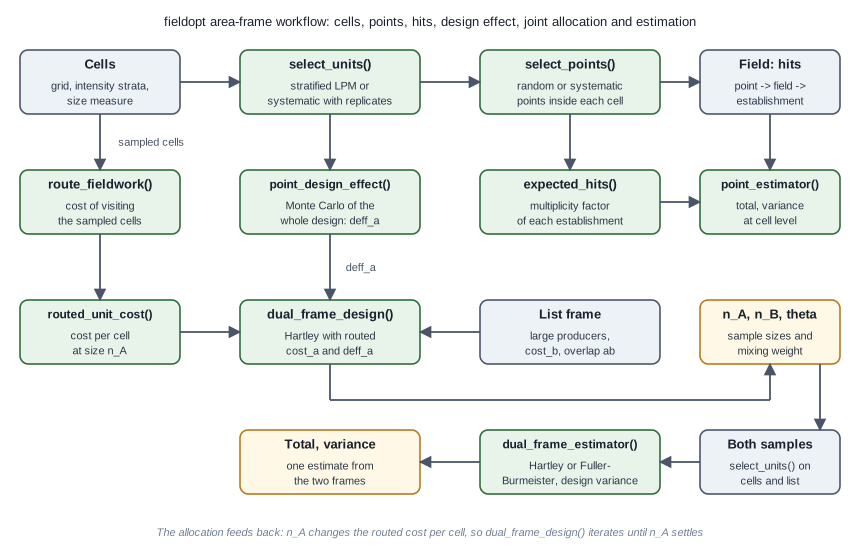
territory.select_points(), expected_hits() and
point_estimator() implement point sampling inside the
selected cells and the multiplicity estimator (each hit of an
establishment counts, divided by its expected hits).segment_estimator() gives the closed, open and weighted
segment estimators; design_variance() the Horvitz-Thompson
total with the variance estimator that matches the design (local-mean,
replicates, SRS); ratio_estimator() uses a known auxiliary
total; dual_frame_estimator() combines the area and the
list samples (Hartley with a fixed, screening or estimated weight;
Fuller-Burmeister).frame_allocation() allocates across strata for a target
variance or a budget; multivariate_allocation() does it for
several study variables at once (Bethel);
dual_frame_allocation() is Hartley’s allocation for an area
frame plus a list frame with overlap, with the optimal mixing weight or
the screening design; two_stage_allocation() is Cochran’s
two-stage allocation with the cost function c1 n + c2 n m.
tidy() and glance() read them all.routed_unit_cost(), two_stage_design() and
dual_frame_design() close the loop: the cost of an area
unit is measured by routing a sample of the allocated size, and the
allocation is repeated until it stabilises.point_design_effect() simulates the whole area design
(cells, points, hits, estimator) and returns the bias, the variance and
the design effect of point sampling, the deff_a the
dual-frame allocation asks for.cost_variance_frontier() simulates designs over a grid
of sample sizes and returns the trade-off between field cost and
variance.as_frame(), as_sf() and
read_areaframe() move between spatial layers (or the cells
exported by an area-frame service) and the plain frames the package
works on; frame_overlap() matches a list frame to the cells
and marks the overlap domain; as_svydesign() hands a sample
to the survey package for calibration, domains and
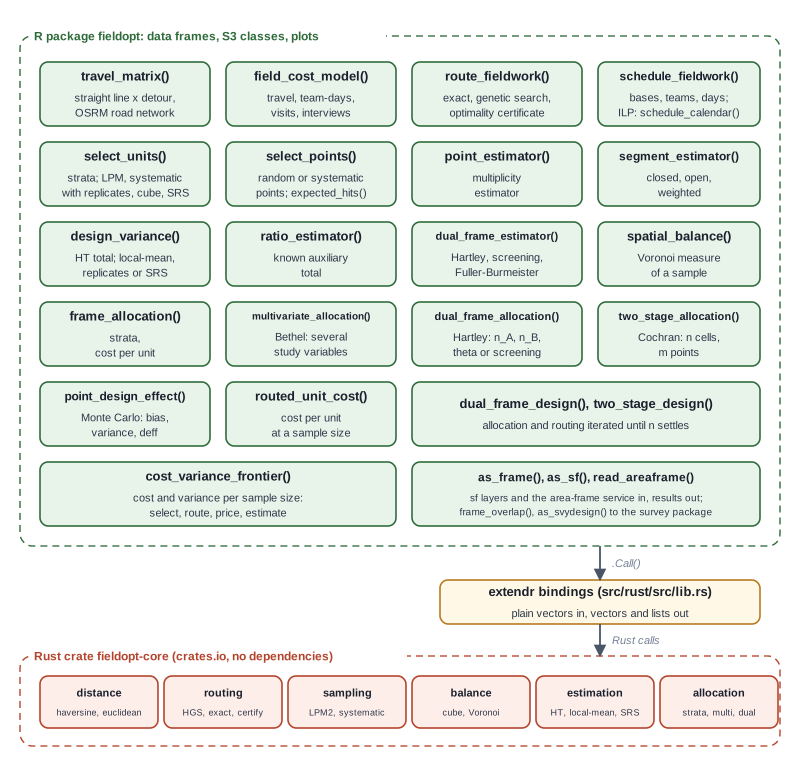
nonresponse adjustment.The numerical engine is the Rust crate fieldopt-core,
usable on its own from Rust or from other languages.
The development version needs a Rust toolchain (cargo
and rustc 1.70 or later, from https://rustup.rs):
# install.packages("pak")
pak::pak("castlaboratory/fieldopt")library(fieldopt)
library(dplyr)
set.seed(1)
frame <- tibble(
unit = c("depot", paste0("s", 1:40)),
x = c(5, runif(40, 0, 10)), y = c(5, runif(40, 0, 10))
) |>
mutate(crop = if_else(unit == "depot", NA_real_, 20 + 3 * x + rnorm(n())))
model <- field_cost_model(
per_travel = 2, per_unit = 30, per_interview = 10,
interviews_per_unit = 4, currency = "BRL"
)
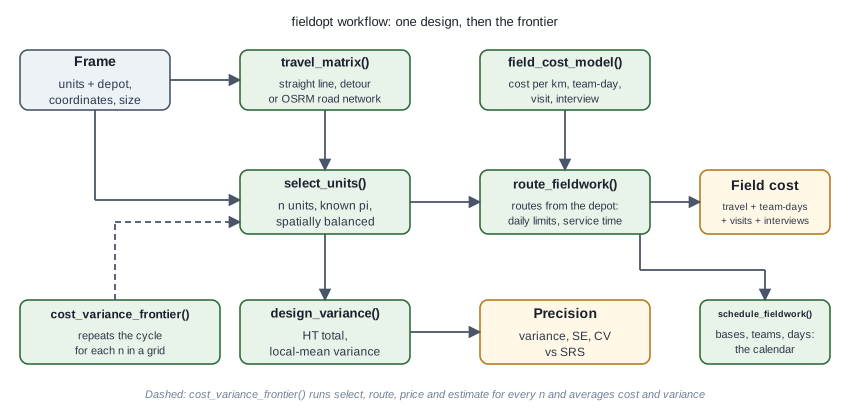
# one design: select, route, price, estimate
s <- frame |>
filter(unit != "depot") |>
select_units(n = 12)
r <- s |>
travel_matrix(bases = frame |> filter(unit == "depot"), method = "euclidean") |>
route_fieldwork(units = s, depot = "depot", max_stops = 5, cost_model = model)
r
design_variance(s, y = "crop")
# the frontier across sample sizes
f <- cost_variance_frontier(
frame,
depot = "depot", cost_model = model,
n_grid = c(8, 12, 16, 24), y = "crop",
method = "euclidean", max_stops = 5, n_rep = 10
)
autoplot(f)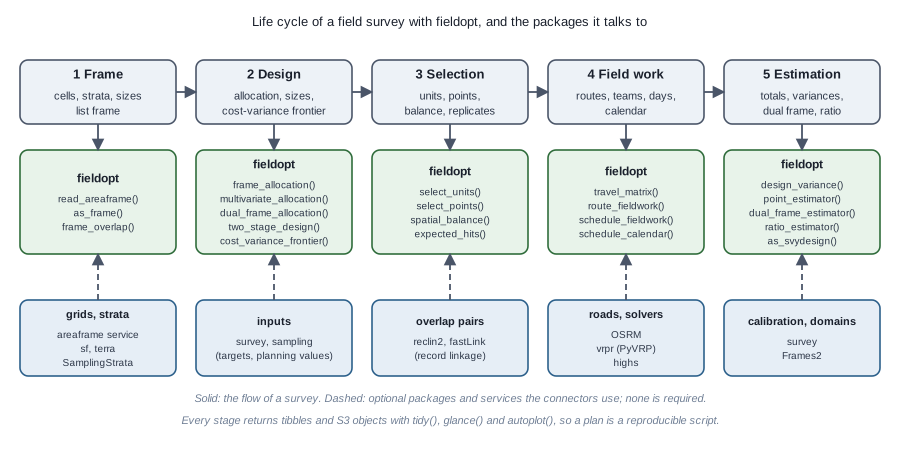
Spatially balanced sampling and its variance estimator follow
Grafström, Lundström and Schelin (2012) and Grafström and Schelin
(2014), as implemented in BalancedSampling; the allocations
are Cochran’s (1977) cost-optimal allocations and Hartley’s (1962, 1974)
dual-frame design; the dual-frame estimators (Hartley,
Fuller-Burmeister, Kalton-Anderson, pseudo-maximum likelihood,
calibration) are in Frames2. What fieldopt
adds is the design side with the routing and the cost model, so that the
field cost of a design is computed instead of approximated by the sample
size.
André Leite (UFPE), Raydonal Ospina (UFBA) and Cristiano Ferraz (UFPE), CAST Lab. Licence GPL (>= 3).