


Performs likelihood-based extreme value inferences with adjustment for the presence of missing values. A GEV distribution is fitted to block maxima using maximum likelihood estimation, with the GEV location and scale parameter reflecting the numbers of non-missing raw values in each block. A Bayesian version is also provided. For the purposes of comparison, there are options to make no adjustment for missing values or to discard any block maximum for which greater than a percentage of the underlying raw values are missing. A plot method provides a set of standard model diagnostic plots, with appropriate adjustment made for the presence of missing values. Example datasets containing missing values are provided.
The evmissing package was created to accompany Simpson
and Northrop (2026).
The main function in evmissing is
gev_mle(), which fits a GEV distribution to block maxima
using maximum likelihood estimation, with the option to make an
adjustment for the numbers of non-missing raw values in each block.
Our adjustment is based on the strong assumption that missing values occur completely at random. We suppose that a block maximum \(M_n\) based on a full block of length \(n\) has a GEV(\(\mu\), \(\sigma\), \(\xi\)) distribution, with distribution function \(G(x)\). Let \(n_i\) be the number of non-missing values in block \(i\) and let \(M_{n_i}\) denote the block maximum of such a block. We suppose that \(M_{n_i}\) has a GEV(\(\mu(n_i)\), \(\sigma(n_i)\), \(\xi\)) distribution, where \(\mu(n_i) = \mu + \sigma [(n_i/n)^\xi -1] / \xi\) and \(\sigma(n_i) = \sigma (n_i/n)^\xi\). These expressions are based on the supposition that \(M_{n_i}\) has a distribution function of \(G(x)^{n_i/n}\), where \(n_i/n\) reflects the effective block size for block \(i\) relative to the full block size.
We illustrate this using the data BrestSurgeMaxima,
which is a data frame containing annual maximum sea surge heights (in
cm) at Brest, France for the years 1846-2007 inclusive.
library(evmissing)
head(BrestSurgeMaxima)
#>      maxima notNA   n block
#> 1846 59.987   361 365     1
#> 1847 58.873   344 365     2
#> 1848 59.749   366 366     3
#> 1849 49.547   365 365     4
#> 1850 55.512   365 365     5
#> 1851 69.422   365 365     6
In addition to the annual maxima this data frame includes
notNA, the number of days in each year for which raw data
were available, and n, the number of days in the year, that
is, the block length. The function block_maxima() can be
used to create data of this format from a raw time series and
information about how blocks are defined. Alternatively, we can provide
a raw time series directly to gev_mle().
# Make the adjustment
fit_adjust <- gev_mle(BrestSurgeMaxima)
summary(fit_adjust)
#>
#> Call:
#> gev_mle(data = BrestSurgeMaxima)
#>
#>       Estimate Std. Error
#> mu    52.89000     1.0650
#> sigma 11.84000     0.7361
#> xi    -0.02375     0.0445

# Make no adjustment
fit_no_adjust <- gev_mle(BrestSurgeMaxima, adjust = FALSE)
summary(fit_no_adjust)
#>
#> Call:
#> gev_mle(data = BrestSurgeMaxima, adjust = FALSE)
#>
#>       Estimate Std. Error
#> mu    52.27000    1.07300
#> sigma 12.09000    0.76170
#> xi    -0.03005    0.04388
The most obvious difference between these model fits is that the estimated location parameter with adjustment (52.27 cm) is smaller than that when the adjustment is used (52.89 cm). This is as expected because if some of the data that could contribute to an annual maximum are missing then the observed annual maximum is stochastically smaller than the unobserved maximum based on full data.
Alternatively, if the argument adjust to
gev_mle() is a numeric scalar then any block maximum for
which greater than adjust percent of the underlying raw
values are missing is discarded before fitting a GEV distribution, with
no further adjustment made.
The plot method for an object returned from gev_mle
creates visual model diagnostics like those described in Coles (2001)
and implemented in Heffernan and Stephenson (2018), where the values
plotted have been adjusted, where necessary, for the presence of missing
values.
plot(fit_adjust)
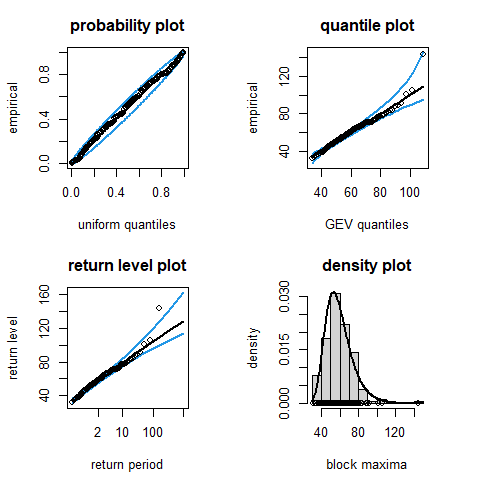
We see that overall the GEV model fits these data well, although the largest annual maximum sea surge height lies outside the profile-based 95% confidence interval that is relevant to this observation.
To install the current released version from CRAN:
install.packages("evmissing")